Surprising history of EV cars

What did we lose when the development of electric cars was abandoned 100 years ago? Possibly a century of research, development and innovation that would have likely led to every household having more electricity than they could use today.

A world where electricity powered everything using technology we can’t imagine, and fossil fuel technology would have been confined to the history books under a chapter called “What were they thinking?”.

There are plenty of stories of people inventing or discovering free energy sources and having their patents confiscated by governments. Real or conspiracy theory? Do your research and decide.

Bottom line, it was Ford’s Model T that ultimately killed off the electric car in 1912, but do a little research and you’ll find the first EV was on the drawing board in 1828 (that’s right; 1828). Almost simultaneously inventors in Hungary, the Netherlands and North America thought electricity was the best way to replace the horse.

American inventor Robert Anderson had a working electric car in 1832, but it wasn’t until 40 years later that they became an option for the car-buying public.

In case you are wondering, research into electricity goes back to at least the 1600s (English scientist William Gilbert ), but it was Alessandro Volta’s battery of 1800 that provided a reliable source of electrical energy and opened the way for portable electrical power.

Ignoring for a moment the resurgence of the electric car currently, it was about 100 years ago that they first hit the streets to compete with big oil, the internal combustion engine and steam.

Between 1900 and 1912 a third of all cars on the roads in the US were electric. People liked them for the same reason they like them today. They are quiet, have no emissions and are easy to drive. Inventor Thomas Edison, perhaps assisted by superior side-kick Nikola Tesla, was among those who worked to develop and improve electric car performance.

Early petrol cars had to be hand-cranked to be fired up, something ladies wouldn’t be seen doing a century ago. Car owners literally had to turn the internal combustion engine over using a leaver inserted into the front of the engine. Plenty of people broke their wrists as the starting handle flew back when the engine fired up.

Because of this, electric cars were initially marketed to ladies. Just turn the key and press play. No noise, no hand-starting, no troublesome gear changes.

The death knell came for electric powered cars in 1912 when Henry Ford sold the Model T with an electric starter. This appendage to the internal combustion engine killed electric cars off. Petrol cars were cheaper to buy than electric ones, were faster than electric cars, and there were no range limitations.

Lifting the bonnet on an early electric car, batteries where the petrol engine is normally found.

By around 1935 you’d be hard pushed to find an electric car on the road anywhere, and the commerce created by petrol stations as a retailer of much more than just fuel was an added bonus for the oil firms of the day.

But what if Henry Ford had got behind the electric powered car? Electricity was good enough to start his petrol engines after all!

Imagine where we would be today. Because the technology of creating power, harnessing it, and storing it would be leaps and bounds ahead of where we are today, and that technology would by now have made it into our homes. You could call it the lost century of innovation.

Had Ford chosen a different track, and had big oil not been so powerful, then the technology to produce near free clean power would have made centrally generated power and distribution along thousands of miles of wire cables obsolete. Each home would have its own safe and clean power source.

We would also have avoided countless environment disasters in accessing and transporting oil – not to mention wars to secure supplies of the black gold. Pick a war or conflict since the 1970s and oil is likely at the root of it.

During the past 50 years there have been occasional fuel shortages – mostly man-made. This has led to people looking at alternatives to fossil fuel technology; in the 70s, 80s and 90s electric cars were developed and abandoned.

The most successful of these was GM’s EV1 in 1996. Strangely, this futuristic looking car wasn’t sold to customers – it was a lease-only vehicle (mainly in California). This made it very easy for GM to take them all back in 2002 and crush most them; a few made it into museums.

An EV charging station a century ago.
An EV charging station 2019.

Some hardened supporters of the EV1 claim GM caught on that it was losing money in parts and the servicing of cars that didn’t need much in the way of lubrication, spark plugs, cooling, oil and air filters etc. They also blame the oil industry for putting pressure on GM to get EV1s off the road – something GM denies.

GM maintains it couldn’t develop battery technology fast enough to meet demand for its electric cars, and so rather than invest, it abandoned the idea altogether.

Another opportunity lost; because just 10 years after GM pulled the plug, and 100 years after the internal combustion engine killed electric cars the first time, car manufacturers everywhere started heavily investing in electric vehicle technology.

In dropping the ball many times, the major car manufacturers have given a number of challenger brands space to enter the market – Tesla among them, plus myriad car manufacturers in China.

Sure, there’s still a long way to go to get the price of electric vehicles down – but the trend of increased adoption of electric cars is up; so prices will come down.

However, despite the ‘green’ perception of electric vehicles, mining some of the raw materials required to make them is causing concerns due to pollution and other environmental and social issues. Not to mention the electricity these cars need is frequently generated by fossil fuel technology (New Zealand is fortunate to have hydro and wind-powered generators).

Nevertheless, diesel engines are on the way out thanks in part to VW’s emission software shenanigans, and petrol will follow. I think you’d be hard pushed to buy a new fossil fuel car by 2030 and by 2050 internal combustion engines will be a distant memory. Museum pieces.

When one thinks of all the environmental disasters caused by oil, and the lost lives in the wars for it, one can only hope that this time electric cars will get a foothold and the technological catch-up can begin. Because with near free energy in the home, almost anything is possible.

But the good news is Ford is to build an all-electric car from the ground up – and it may look a little like the popular Mustang. Any colour you like; so long as it’s red.

The Prisoner – 60s TV series review

Actor Patrick McGoohan sitting on a ledge with the Portmeirion village and coast (North Wales) in the background.

I am not a number, I am a free man!

There are still plenty of people who haven’t managed to sit through all 17 episodes of 1960s British cult TV series The Prisoner.  I can understand their frustration as the show doesn’t follow the ‘normal’ hero-beats-the-baddy formula with everything neatly tied up with a bow at the end of each episode.

Neither the episodes, nor the series, follow a straight line. It’s illogical, confusing, intriguing, unique, challenging, experimental, weird even. Which is why it is still such compelling viewing decades after it was made. During its first broadcast in 1967, and subsequent repeats, it drove some viewers to distraction.

The plot

Okay, so what is The Prisoner all about?

On the surface; a man resigns from a top government job during a table-thumping tiff with a stiff Civil Servant, then drives home in a spiffing Lotus Seven S II, goes indoors (1 Buckingham Place, London) to pack for a holiday. He is put to sleep with gas pumped into his home and wakes up in The Village, apparently located on a remote island somewhere in Europe.

Waking up in a home with an interior identical to his London pad, our hero, Number 6 (Patrick McGoohan), is pressured by Number 2 (played by various actors during the series) to reveal why he resigned. But despite the psychological games and mind-altering drugs, Number 6 refuses to tell (he just wanted a break and a holiday).

Bottom line, he can’t decide if he is being held prisoner by his own people or a foreign power. If he reveals anything about his secret work then he’d never be allowed to leave (deemed untrustworthy to keep his mouth shut). One person will have to be broken, Number 6 or Number 2.

The Village is like a retirement home for people who know too much, they live a life of anonymity (numbers only please) and total control.

(The Prisoner may have been based on a place operated by the UK government’s Inter Services Research Bureau in Scotland).

Apart from the goodie-baddie push-pull story line, the show goes deeper as Number 6 kicks back against the system and the establishment. When he shouted “I am not a number, I am a free man!” it was McGoohan’s warning about the incoming world where everyone from birth really is filed, stamped, indexed, briefed (educated), and numbered.

Total surveillance

In the show we see a total surveillance society with cameras dotted across The Village and in the homes people live in. The only entertainment is piped music and the Tally Ho  ‘newspaper’ owned by those running The Village (no dissenting voices in this publication).

Neither Number 6, nor his village cohorts, are free to live their lives as they wish. They have the appearance of being free – as they can walk around The Village, go to restaurants, play games, some take a job to earn credits in this cashless society, and villagers even vote in an election that changes nothing but the name of the person in the high tower.

But they are not free to leave the village or enjoy any privacy.

Actor Patrick McGoohan driving a yellow S2 Lotus Seven sports car as seen in the opening sequence of the TV show The Prisoner.
Actor Patrick McGoohan driving a yellow S2 Lotus Seven sports car in the opening sequence of the TV show The Prisoner.

Who is Number 1?

But what I wanted to know, what we all wanted to know, is who is Number 1?

Each week we sat through an episode hoping for a clue. There were no clues. Some episodes were simply mind-boggling; probably due to the fact McGoohan had originally pitched a series of seven episodes to TV producer Lew Grade. Grade asked for 26 and got 17. So the plot was stretched way beyond McGoohan’s original vision (he didn’t even appear in one episode at all).

Ultimately Number 1 is revealed. He is wearing a white hooded cloak, has a crystal ball, and as he lifts his head we see a black and white mask that’s removed by Number 6 to reveal a monkey mask. Then, with the monkey mask pulled away, the mysterious monk-like figure is revealed to be Number 6. Confusingly, Number 6 is seen to pull the mask off Number 6 (not a typo). He is his own prison guard.

Our hero escapes back to London only for the front door of his home to open automatically – just like it did in The Village. He’s no more free here than he was in The Village (a prisoner of the system).

The ending caused the British viewing public to go bananas – jamming phone lines at the TV station. McGoohan – who created the show – said in later interviews that he had to go into hiding for a while; in Wales, well away from telephones; something that could be done in 1967 (imagine what would happen today with trial by social media).

Explaining the show McGoohan said Number 6 is Number 1, and Number 1 is you – the viewer.

So what’s the main take-away from this science fiction, drama, psychological thriller that is The Prisoner?

To paraphrase McGoohan, I guess it’s that you (dear reader) are number 1, you decide what to do, you don’t need permission, you are free to engage as much or as little as you like in society. Your life is your own; even if you have been filed, stamped, indexed, briefed, and numbered.

A still from the TV show The Prisoner showing actor Patrick McGoohan, playing Number 6, campaigning in an election.

The Village is real

‘The Village’ is a tiny resort called Portmeirion in Gwynedd, North Wales in the UK.  When the show was first broadcast few people had any idea Portmeirion existed (although it was revealed in the end credits of the final episode).

During the 1980s I visited Portmeirion and it looked much the same as it did 20 years earlier in the TV show (quite a surreal experience). It still hadn’t changed much on a second visit in the early 90s.

A look at Portmeirion’s website reveals the location is still thriving and no doubt all visitors are given a number upon entry.

A Prisoner convention, organised by the TV show’s official appreciation society Six of One, is held there every year (not to be confused with an annual pop concert that has nothing to do with the TV show at all).

Debs McDougall, a member of Six of One, kindly sent me details of a plaque commemorating the TV series that sits above the door of the Prisoner Shop (which was Number 6’s home in the TV series (the exterior). The plaque was officially unveiled by Fenella Fielding (the voice of The Village) on 13 May 2005.

There is a second plaque dedicated to Patrick McGoohan on the wall of the White Horse cottage (where the actor and his family stayed while filming on location). And there is a bust of Patrick near the entrance of the village which was unveiled by Patrick’s daughter Catherine on 29 September 2017 – the year of the show’s 50th anniversary.

Also in 2017 a permanent chess board was installed on the village lawn. Members of Six of One were the first people to play a game on it. Hopefully it ended with a Checkmate.

So it is great to know the owner of The Village – a charitable trust – hasn’t forgotten how this slice of Wales (a great destination for a family holiday) was put on the world map.

Actor Patrick McGoohan, playing Number 6, in a behind-the-scenes still on the beach at Portmeirion with a white balloon - Rover - along with crew members and camera operator.
Actor Patrick McGoohan, playing Number 6, in a behind-the-scenes still on the beach at Portmeirion with a white balloon – Rover – along with crew members and camera operator.

The Prisoner remade

Patrick McGoohan was offered a small role in the reinterpretation of The Prisoner – the old man seen escaping at the start of the first episode. However, he declined the offer while asking to play Number 2 (which would have been fantastic).

It’s a shame the American producers didn’t accommodate the creator and driving force of the series… Shooting took place in 2007, it was first broadcast in 2009, and reviews were less than favourable (so maybe Patrick McGoohan was best out of it…).

Random fact

Some of the sound effects used in The Prisoner (1967) were first heard in the movie The Ipcress File (1965).

Patrick McGoohan: 19 March 1928 to 13 January 2009.

For more about The Prisoner see the show’s official appreciation society website  Six of One

Read about The Truman Show and its link to The Prisoner.

Be seeing you…

Patrick talks about The Prisoner.

You’re never too old to rock

If you listened to Alan Freeman’s Pick of the Pops on Britain’s Radio One you would have heard the Australian DJ present a tightly formatted radio show featuring the week’s top 30.

It was compelling listening for anyone wanting to know the week’s number one, and Freeman certainly put a lot of energy into his shows. Way back when, it almost mattered what the week’s top selling single was.

Freeman hosted the countdown show from 1967 until 1972, he remained on air until 2000, and his signature song, At The Sign Of The Swinging Cymbal, became synonymous with him and his shows – so much so that there are generations of people who, when hearing it, think of Freeman.

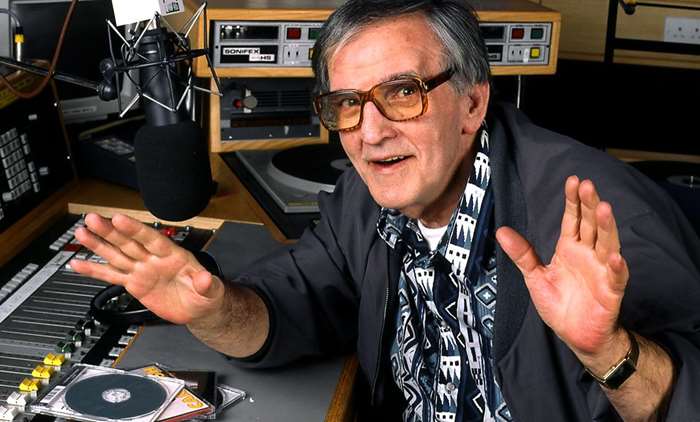
Alan Freeman prepping for a show on Radio One.

As a wannabe DJ in the 70s I marvelled at his presentation style and perfect diction. His use of classical music and rock song segments to punctuate his shows was masterful too.

Freeman was born in New South Wales, Australia, on 6 July 1927 and as a youngster dreamed of being a singer. His first job as a pay clerk was at a timber firm. In 1952 he auditioned to be a radio announcer for 7LA Tasmania, and the die was cast.

By 1957 he was at 3KZ in Melbourne, but the travel bug had bitten, and so he headed to the UK – initially for nine months. His boss at 3KZ agreed to keep a job open for him, but Freeman was never to return.

London

Unimpressed with the output of the BBC in the UK, about the only game in town at the time, he went to Radio Luxembourg. By 1960 he landed a gig at the BBC and his career started to take off.

He subsequently went from hosting a light programme show to being a presenter at Radio One – a station launched by the BBC in 1967 solely to compete with popular off-shore pirate stations such as Radio London and Caroline – which had just been outlawed.

In 1979 he left the BBC to work at London’s top commercial station Capital Radio, but returned to the Beeb in 1989 for a rehash of his Pick of the Pops show, this time called Pick of the Pops – Take Two.

Sacked

In 1993 Radio One had a massive clear-out of popular and established DJs and Freeman was swept out with other big names. He continued broadcasting though, collected up an MBE along the way and eventually returned to the BBC, this time on Radio Two where he worked until he retired in 2000 aged 73 (that’s not a typo, he was DJing at Seventy Three!).

While there were questions about Freeman’s personal life, the presenter spent his professional career at the top of his game as a shining example of what a good radio host can and should do.

He added sparkle and energy to his shows, surprised listeners – with rock and classical drop ins, ad-libs, and laughed off his own on-air fluff ups (fluff Freeman) – each show had a beginning, middle and an end.

His on-air catchphrase ‘Alright?’ was aimed at the engineer on the other side of the glass.

Alan Freeman MBE: Born 6 July 1927. Died 27 November 2006.

Roger Moore – Goodbye, Mr Bond

Goodbye, Mr Bond

I was thinking about actor Sir Roger Moore just last week while travelling on the bus. I remembered him playing James Bond of course and saying in an interview that he blinked every time he pulled the trigger of a prop gun when ‘shooting’ a villain. This made it hard for movie directors to get the money shot of Bond taking out a baddy.

Then I recalled that he was against animal cruelty – including fox hunting – and had volunteered to help children’s charity Unicef. He seemed a jolly good chap in my book.

So it was sad to hear he died this week (23 May 2017) aged 89. Not a bad innings.

My first memory of Roger Moore was as TV’s The Saint. The show was a hit in the 1960s, and as a child I watched in awe as his character, Simon Templar, solved the crime and got the girl every Sunday night. He was always one step ahead of occasional character inspector Claude (Ivor Dean), who added some comedic moments to the show.

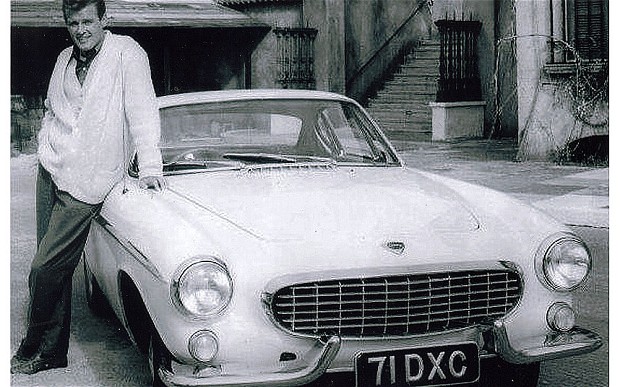
The car Roger drove in later episodes of The Saint was a cool sporty number surprisingly made by Volvo. Who’d of thought?! The most boring car company in the world used to make sports cars.

The Volvo P1800 coupe used in the show was white, had been made in 1962 and had the TV number plate ST1. The car was rediscovered in the 1990s rotting away in a farmer’s yard, but an enthusiastic chap restored it during the course of 16 years.

Roger Moore as The Saint (Simon Templar) with the character’s Volvo P1800.

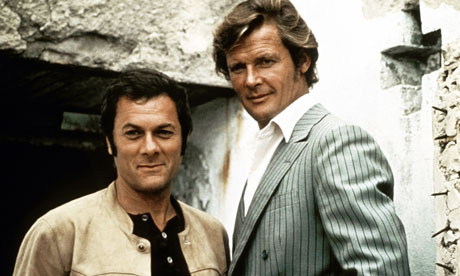
In 1971 Roger became one half of The Persuaders with actor Tony Curtis (Danny Wilde).  Roger (Brett Sinclair) played a well-heeled toff.  Wilde drove a Ferrari Dino 246GT while our eyebrow-raising action hero sat behind the wheel of a yellow Aston Martin DBS. I know which one I prefer.

The Persuaders was a great show for a young teenager, it was like The Saint on steroids. Foreign locations, car chases, and the then novelty of a wise-cracking Yank as a foil to the reserved Brit.

Tony Curtis (left) and Roger Moore in a still for TV show The Persuaders.

But we mustn’t forget the music, for the show introduced me to the work of John Barry. He wrote The Persuaders‘  theme tune which had a strong synth bass line – just brilliant. From the moment I heard it I knew I wanted a synth (ideally a Moog, or an Arp, or in fact – any synth. Does a Casio count?).

John Barry had previously arranged the iconic James Bond theme for the first Bond film. The tune was written by Monty Norman (as established by two court cases, and he’ll sue anyone who says differently). The dum dee dee dum dum tune has been used in almost all the Bond films.

Roger Moore’s first outing as Bond was in the brilliant Live and Let Die (1973),  he was the oldest actor (45) to have played the British spy.

James: There seems to be some mistake. My name is…

Mr. Big (interrupting): Names is for tombstones, baby!

Moore was essentially replacing the popular Sean Connery as 007 following the public’s lukewarm reception of Australian George Lazenby’s outing as Bond in On Her Majesty’s Secret Service. This film was followed by Connery reluctantly returning to the role in Diamonds Are Forever.

Then came Moore in Live and Let Die – and this movie had it all. Great cars, beautiful women (of course…), superb locations, a brilliant score, an opening song by Paul McCartney, and gadgets galore.

“Now pay attention Bond.”

Who doesn’t remember the gas bullet that inflated one baddy to twice the size of Bond’s ego? Or the spinning bezel on Bond’s Rolex that cut through rope and also featured a powerful electronic magnet (aren’t we supposed to keep magnets away from watches?).

James: You see, sir, by pulling out this button, it turns the watch into a hyper-intensified magnetic field. Powerful enough to even deflect the path of a bullet…at long range.

M: I feel very tempted to test that theory right now.

Having seen the watch in the film a friend and I spent hours pulling apart my broken (budget) diver’s watch and trying to figure out how to fit a high-torque motor and battery into the casing of the watch and turn the bezel into a buzzsaw. We were only missing two things; a miniature high-torque electric motor and a teeny-weeny battery.

There was no hope, we gave up, and years later I learned the bezel on Bond’s wrist spun at high speed thanks to a huge tank of compressed air – which meant the watch wasn’t on Moore’s wrist when it cut through rope.

And if you think about it; having a buzzsaw on an actor’s arm might have caused some insurance issues… Yes, it’s all props, make-believe, and a false ‘arm’ that looks plastic if you look carefully when the bezel is spinning.

The watch was sold at auction in 2015 for US$365,000 (and it doesn’t even keep time).

It is worth noting though that Bond is first seen in Live and Let Die with a new-fangled digital watch with a red LED display. Bond had to press a button to illuminate the numbers.

Roger More in a still promoting Live and let Die, with actors Gloria Hendry (left) and Jane Seymour (right).

Roger Moore did brilliantly as Bond in Live and Let Die, and he would  have joined the franchise at its outset (instead of Connery) had he not been tied to TV shows.

Moore played Bond more times than any other actor, but his spy movies were a mixed bag. Octopussy must be the worst of all Bond movies – the franchise had really lost its way at this point and Roger Moore’s light-hearted take on the Bond character (a trained killer) was wearing thin.

In my opinion his best Bond outings are: Live and Let Die (just an exciting ride, particularly on the bus), The Spy Who Loved Me (brilliant opening gambit, Jaws, and underwater car), and For Your Eyes Only (fewer gadgets and more grit – but the teen skater character was silly).

Sitting in the middle is The Man With the Golden Gun. But among the misses are Moonraker (just too fanciful – even for Bond), Octopussy (I have no words…paper thin plot), and A View to a Kill (Grace Jones is a villain, yeah na).

Roger Moore had a good run playing Bond, but lacked the look of a hardened killer. But no one has played Bond like Moore, and if there is any criticism of his portrayal of the British spy created by Ian Fleming, then we must first look to the producers, script writers, and movie directors.

When the rot sets in it normally starts at the top.

Moore of course appeared in dozens of other movies, and one that comes to mind saw him fight his double. The movie, The Man Who Haunted Himself, is a forgotten psychological thriller from 1970 that’s well worth hunting down.

Moore was an actor of the old school, seeking publicity only when it was needed (or when he was contractually obligated to do so). A gentleman, a top chap, and an all-round nice guy.

Cheers Roger, take it easy in Double O Heaven.

Sir Roger Moore KBE: 14 October 1927 – 23 May 2017.

Copyright Steve Hart.